Iframe SEO Impact Explained: Are Iframes Bad for SEO or Just Misunderstood?
- Uprango Seo
- Jan 22
- 3 min read

Why Website Owners Worry About Iframe SEO Impact
If you’ve ever embedded a map, video, or external tool on your website, chances are you’ve used an iframe. Almost immediately, a common concern pops up: are iframes bad for SEO?
This question is valid. Website owners want their content to rank well, load fast, and provide a smooth user experience. Conflicting advice online only adds to the confusion about iframe SEO impact. Some say avoid them entirely, while others say they’re harmless.
In this article, we’ll clear up the confusion in a practical, beginner-friendly way. You’ll learn how iframes affect SEO, whether Google indexes iframe content, and when using them actually makes sense.
What Is an Iframe and Why Is It Used?
An iframe (inline frame) is an HTML element that allows you to display content from another webpage within your own page.
Common Uses of Iframes
Embedded YouTube or Vimeo videos
Google Maps
Payment gateways
External forms or widgets
Third-party tools and dashboards
Iframes are popular because they’re easy to implement and allow content to be updated externally without changing your site.
Understanding Iframe SEO Impact
Does Google Index Iframe Content?
Yes, Google can index iframe content, but with important limitations.
Google indexes iframe content as part of the source URL, not necessarily as content belonging to your page. This means:
The SEO value usually goes to the original source
Your page may not benefit from the embedded text or keywords
Rankings depend heavily on context and implementation
So while iframe content can be indexed, it doesn’t always help your SEO goals.
Are Iframes Bad for SEO?
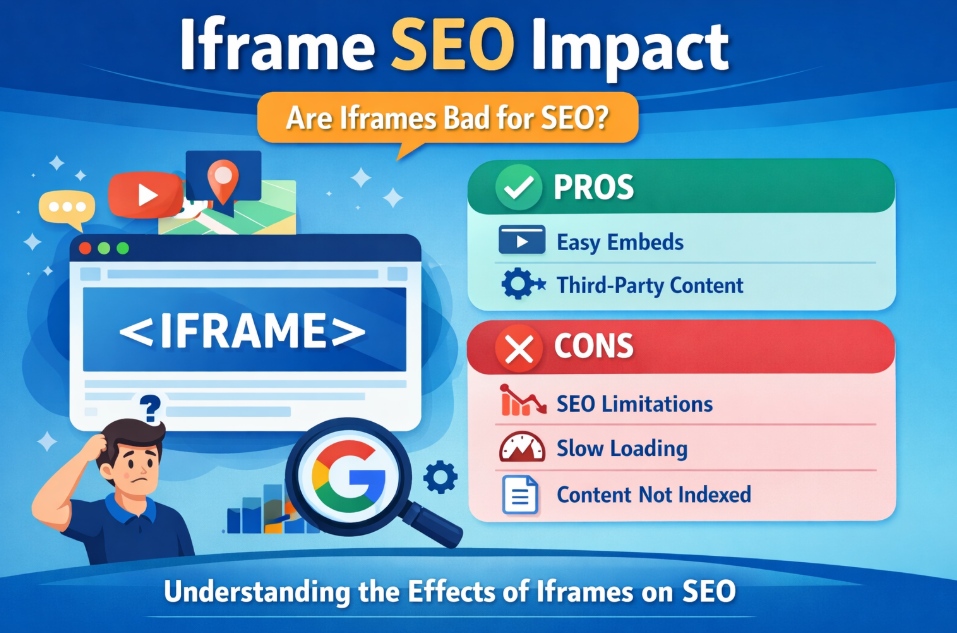
The short answer: iframes are not inherently bad for SEO, but they can cause problems if misused.
When Iframes Can Hurt SEO
Important content (text, headings) is loaded only via iframe
Search engines can’t easily understand the page’s main topic
Overuse leads to poor user experience
Slow loading iframe sources increase page load time
This is why many SEO professionals ask why are iframes bad not because they’re dangerous, but because they’re often misused.
Why Are Iframes Bad in Some SEO Scenarios?
1. Limited Content Ownership
If your core content lives inside an iframe, search engines may not credit your page for it.
2. Crawl Budget Inefficiency
Search engines may prioritize your main HTML content over iframe-loaded resources.
3. Page Speed Concerns
Third-party iframe sources can slow down your site, especially if they’re not optimized.
4. Accessibility Challenges
Some screen readers and assistive technologies struggle with iframe-heavy layouts.
SEO Iframe Content: Best Practices That Actually Work
If you must use iframes, follow these best practices to reduce negative SEO impact:
Use Iframes for Supporting Content Only
Keep your main text, headings, and keywords directly on your page.
Add Context Around the Iframe
Explain what the embedded content is about using SEO-friendly text.
Optimize Page Speed
Lazy-load iframe content where possible and avoid unnecessary embeds.
Use Descriptive Titles and Attributes
Include meaningful title attributes to help accessibility and context.
Combine With Strong On-Page SEO
Internal links, clear headings, and relevant keywords help balance iframe usage.
At UpRango, we often see sites improve rankings simply by restructuring pages so critical content isn’t hidden inside iframes.
Are Iframes Bad for SEO Compared to Alternatives?
In many cases, yes native embeds or API-based integrations are better than iframes. However, for maps, videos, and secure third-party tools, iframes are still widely accepted and practical.
The key is intentional usage, not avoidance at all costs.
Conclusion: The Real Truth About Iframe SEO Impact
Iframe SEO impact isn’t black and white. Iframes are not bad by default, and Google does index iframe content just not always in your favor.
To summarize:
Iframes are fine for embeds and external tools
Avoid placing critical SEO content inside iframes
Focus on context, speed, and user experience
Use iframes strategically, not excessively
When used thoughtfully, iframes can coexist with strong SEO performance without hurting rankings.
Frequently Asked Questions (FAQs)
1. What is iframe SEO impact in simple terms?
Iframe SEO impact refers to how embedded external content affects search engine visibility, indexing, and page performance.
2. Does Google index iframe content?
Yes, Google can index iframe content, but it usually attributes SEO value to the source URL, not the embedding page.
3. Are iframes bad for SEO in 2026?
No, iframes are not inherently bad for SEO, but misuse especially for core content can limit ranking potential.
4. Why are iframes bad for important website content?
Because search engines may not credit your page for content loaded inside an iframe, reducing SEO effectiveness.
5. How can I use SEO iframe content safely?
Use iframes for secondary content, add descriptive text around them, optimize loading speed, and keep primary content in HTML.
6. Should I remove all iframes from my website?
No. Remove unnecessary ones, but keep essential embeds like videos or maps when they enhance user experience.


Comments